OmniSync: The Universal Bluetooth Audio System
Standalone touchscreen hub that synchronizes audio playback across up to five mixed-brand Bluetooth speakers, breaking ecosystem lock-in for group listening.
Overview
OmniSync is the senior design project I worked on at the Milwaukee School of Engineering with teammates Caleb Beddes, Caitlyn Grant, Andrew Schuman, and Duaa Aljalous, advised by Dr. Darrin Rothe. It is a portable, standalone hub that takes a single Bluetooth audio source (e.g. a phone) and broadcasts synchronized audio to up to five mixed-brand Bluetooth output devices within a 10-meter radius.
The goal was to eliminate the ecosystem lock-in of existing multi-speaker Bluetooth systems — letting a user pair whatever headphones and speakers they already own into a single coherent listening setup for parties, outdoor gatherings, and group listening.
Problem
Current consumer Bluetooth audio has a few persistent pain points:
- Poor sound distribution — a single speaker in a large space is often deafening up close but too quiet far away.
- Ecosystem lock-in — multi-speaker Bluetooth systems only work with other devices from the same manufacturer.
- Cost — multi-speaker setups are expensive for the average consumer and labor-intensive to relocate.
Key requirements
- Simultaneous broadcasting — maintain a stable connection to one input source and stream synchronized audio to five Bluetooth output devices within a 10 m radius.
- Advanced audio control — support both "area stereo" and 5.0 surround sound modes, with manual per-speaker channel assignment and per-speaker delay tuning to correct sync issues.
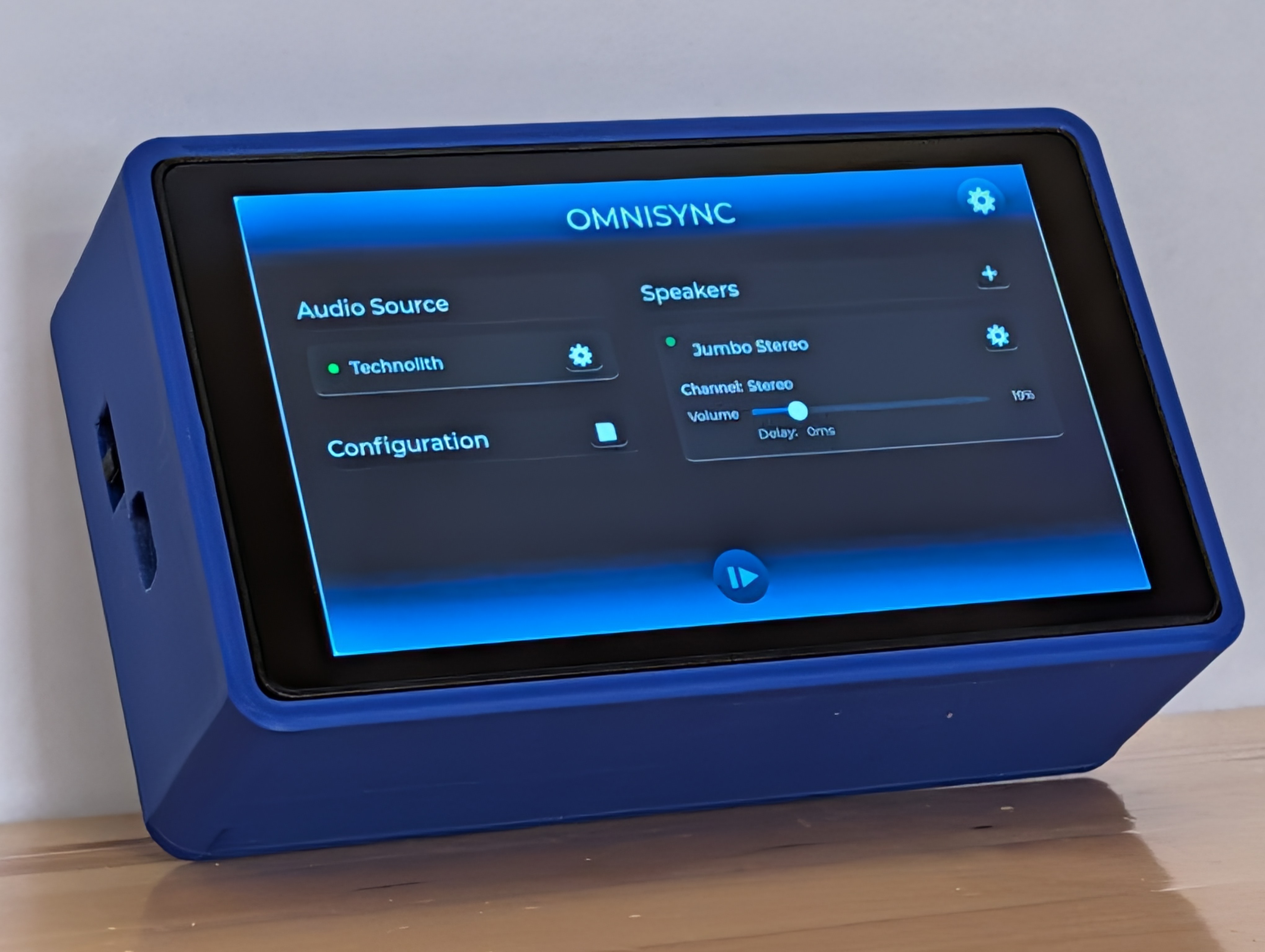
- Intuitive UI — a touchscreen interface exposing every system feature without needing a companion app.
- Portable power — minimum 6 hours of battery life and USB-C pass-through charging with automatic shutoff to protect the battery.
Design
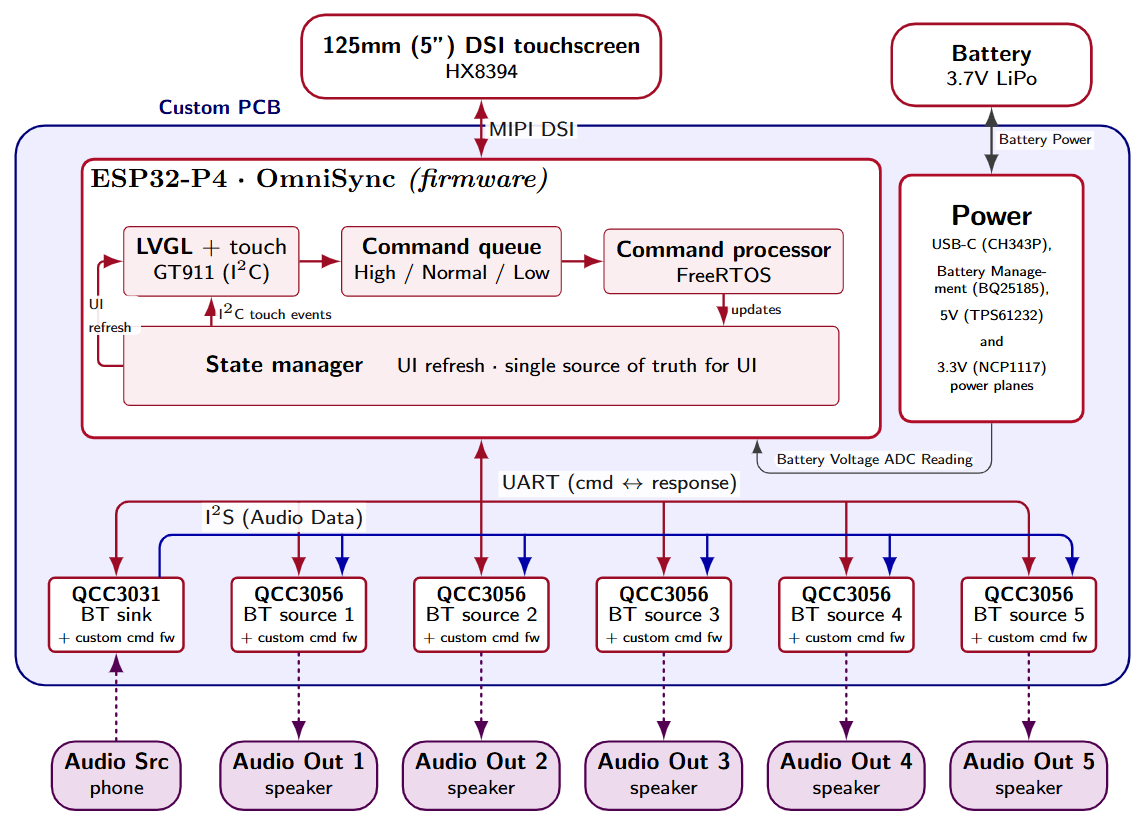
A central microcontroller handles user input on the touchscreen and orchestrates a set of dedicated Bluetooth receiver and transmitter modules over I²S and UART. Splitting the radio workload across dedicated modules keeps each link stable while the main MCU focuses on UI, routing, and synchronization.
- Main MCU: ESP32-P4 running FreeRTOS, with LVGL driving the touchscreen UI.
- Bluetooth radios: 1× QCC3031 for the input source, 5× QCC3056 for the output devices.
- Display: 125 mm (5") IPS LCD with capacitive touch.
- Power: 5000 mAh LiPo with USB-C pass-through charging.
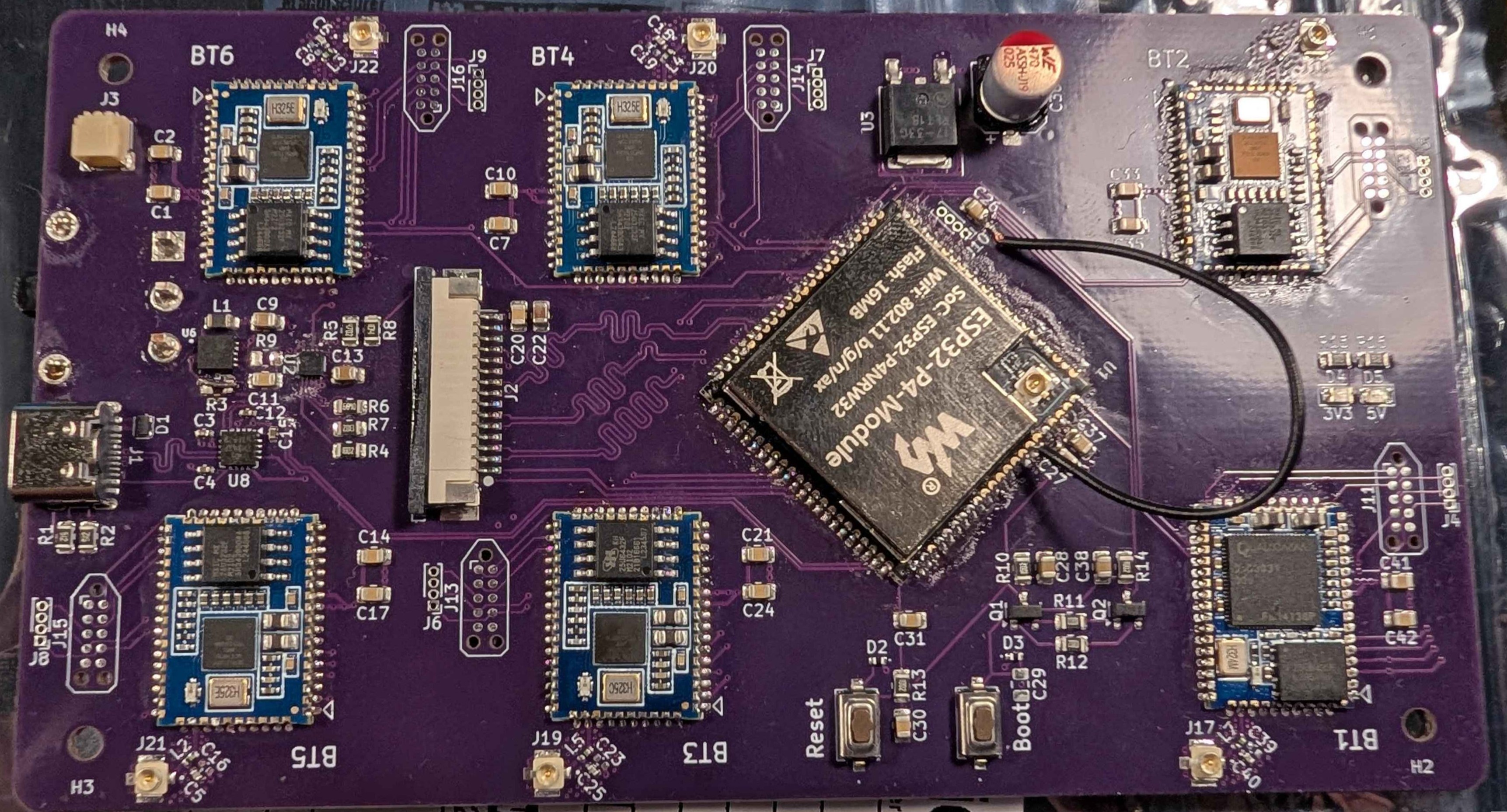
- Custom PCB for power management, audio routing, and signal integrity (I²S lines isolated on the bottom layer).
System features
Everything below is driven from the on-device touchscreen — no companion phone app required:
- Scan, pair, and disconnect Bluetooth devices
- Auto-reconnect to the previous setup on power-up
- Rename the source phone and individual speakers
- Save and load named "room" configurations
- Global play / pause and track skip / seek
- Per-speaker volume control
- Assign surround channels per speaker
- Per-speaker delay tuning for synchronization
- View speaker battery levels and the hub's own battery
- Adjust screen brightness
Constraints & standards
- Economic: must cost significantly less than proprietary multi-speaker sets.
- Physical: lightweight, portable enclosure with adequate heat dissipation.
- Safety: electrical hazard protection, thermal management, and output volume limiting.
- Bluetooth v5.3 (IEEE 802.15.1) governs the wireless link; the prototype uses the prototype exemption, with Bluetooth SIG certification required for commercialization.
- FCC Part 15 (Subpart C) regulates RF emissions — full compliance requires RF shielding, secured U.FL connectors, and lab certification.
- IEC 62368-1 A/V equipment safety standard; full compliance would require moving from passive to active thermal management.
- USB Type-C governs the connector and safe pass-through charging — the prototype is fully compliant.
Outcome
OmniSync meets its design requirements as a fully functional standalone prototype. A user can customize their listening experience with just the hub, a phone as an input source, and up to five Bluetooth speakers. At volume production pricing, the projected cost is roughly half that of the least expensive comparable multi-speaker alternative.
Acknowledgements
Special thanks to our advisor Dr. Darrin Rothe for his guidance throughout the project. OmniSync was generously funded by Field Theory Consulting and MSOE alumnus Mr. Bob Radke.